

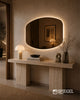
LED mirrors: front lighting or backlighting — which should you choose?
, 8 tempo di lettura minimo
, 8 tempo di lettura minimo
LED mirrors have become an increasingly popular choice for modern bathrooms, bedrooms and dressing areas. As well as adding a contemporary touch to the décor, they offer practical benefits, improving lighting and comfort in everyday use.
However, not all LED mirrors create the same effect. The position of the lighting influences how light is distributed, the atmosphere it creates and the mirror’s functionality.
The main options include front-lit mirrors and backlit mirrors, also known as mirrors with ambient lighting.
Understanding the differences between these options is essential when choosing the right model for each space.
The main difference lies in the position of the light source and the direction in which it shines.
In a front-lit mirror, light is emitted through illuminated areas on the face of the mirror, shining mainly forwards.
This arrangement provides more direct lighting for the person using the mirror.
This makes it a particularly useful option for bathrooms and dressing areas where tasks require good visibility.
Its main benefits include:
Light directed more towards the face;
Greater comfort during washing and personal care routines;
Modern design with integrated lighting;
The ability to supplement the room’s general lighting.
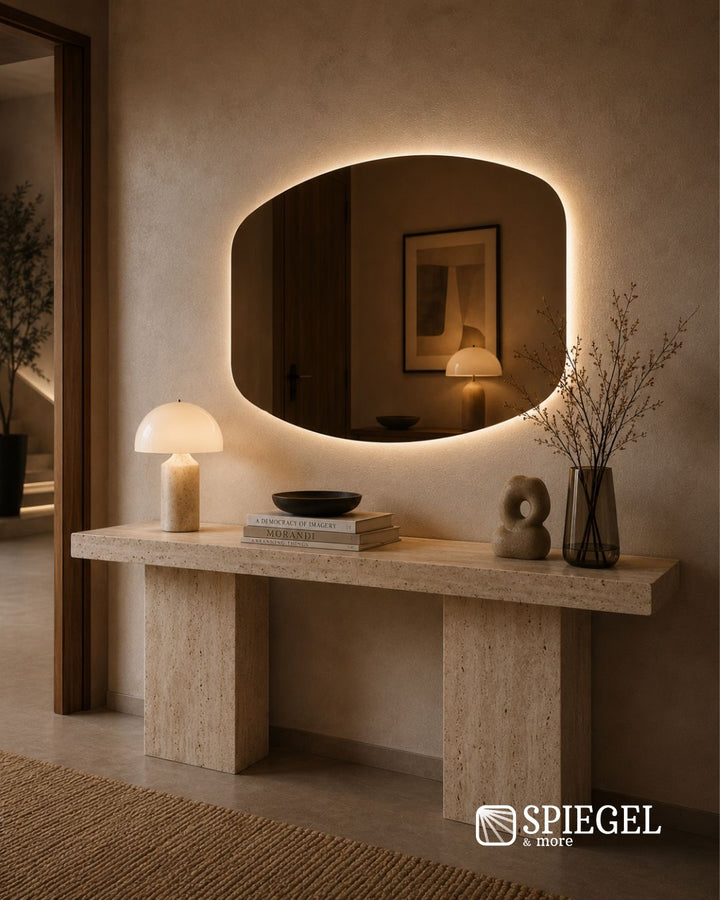
In backlit mirrors, the light source is usually positioned behind the mirror, directing light onto the wall.
This system creates a glow around the mirror, highlighting its shape and adding visual depth to the space.
Backlighting serves a mainly decorative purpose, helping to create a soft, welcoming atmosphere.
The main benefits include:
Creating ambient lighting;
Visually highlighting the mirror’s shape;
Adding a sense of depth to the wall;
Blending into contemporary interior designs;
Providing supplementary lighting without the need for additional decorative light fittings.
A backlit mirror does not always provide enough light for precision tasks such as applying makeup or shaving.
|
Feature |
Front lighting |
Backlighting |
|
Main direction of light |
Forwards |
Towards the wall |
|
Facial lighting |
More direct |
More indirect |
|
Decorative effect |
Contemporary and functional |
Atmosphere and depth |
|
Main use |
Daily routines |
Supplementary lighting |
|
Ideal for |
Bathrooms and dressing tables |
Bathrooms, bedrooms and decorative spaces |
The choice is about more than aesthetics. Consider how the mirror will be used and the other light sources in the room.
The bathroom is one of the spaces where mirror lighting matters most.
Activities such as washing your face, shaving, applying makeup and following a skincare routine benefit from suitable, evenly distributed lighting.
When a mirror is frequently used for personal care, front lighting tends to be the more practical option.
By directing light towards the user, it can help reduce facial shadows, particularly when the lighting is evenly distributed.
For comfortable use, the bathroom should also have general lighting.
If the main goal is to enhance the bathroom’s design, a backlit mirror may be the ideal choice.
The glow on the wall adds a decorative dimension that is particularly appealing in minimalist spaces, where the aim is to reduce the number of visible elements.
This option works well when combined with other light sources that provide the brightness needed for everyday tasks.
In some projects, combining different light sources provides the most balanced solution.
A front-lit mirror can be complemented by ambient lighting, while a backlit model can work alongside lighting positioned to the sides or above it.
The aim is to create a visually comfortable space, avoiding overly bright areas or unwanted shadows.
As well as the position of the lighting, colour temperature influences the appearance of the space.
Colour temperature is measured in Kelvin (K) and determines whether light has a warmer, neutral or cooler tone.
Usually between 2700 K and 3000 K, it provides a warmer, more yellow-toned glow.
It is well suited to relaxing spaces or decorative lighting.
At approximately 3500 K to 4500 K, it offers a balanced appearance suitable for a range of everyday activities.
It can be a good choice for bathrooms and dressing tables.
At higher values, often from 5000 K upwards, it has a whiter, cooler appearance.
It can be useful for certain tasks, although it is not always the best option for creating a welcoming atmosphere.
Before choosing, check the model’s technical specifications, as not all LED mirrors allow you to adjust the colour temperature.
At Spiegel & More, you will find a range of LED mirrors designed to combine functionality and design.
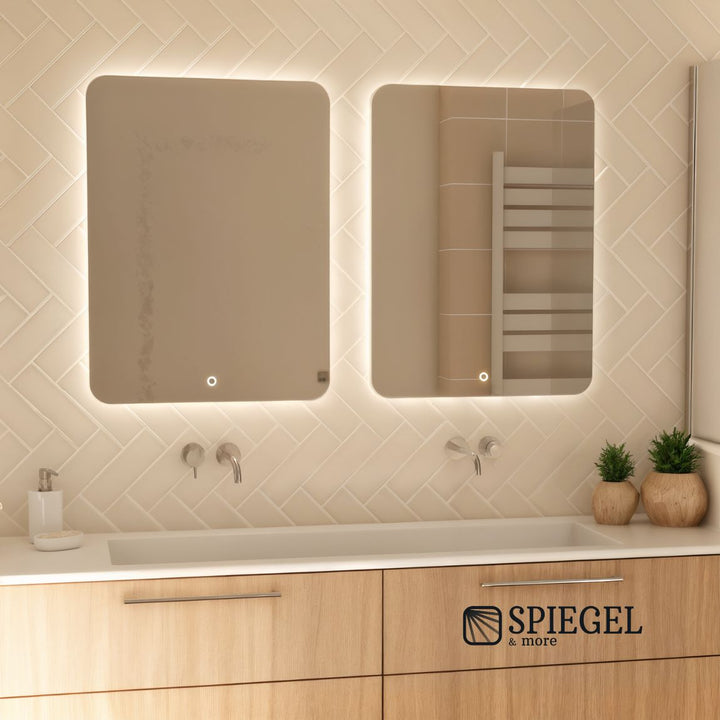
The Tableau Lumineux stands out for its square shape and integrated front LED lighting.
It is an appealing option for bathrooms where geometric design is paired with lighting suited to everyday use.
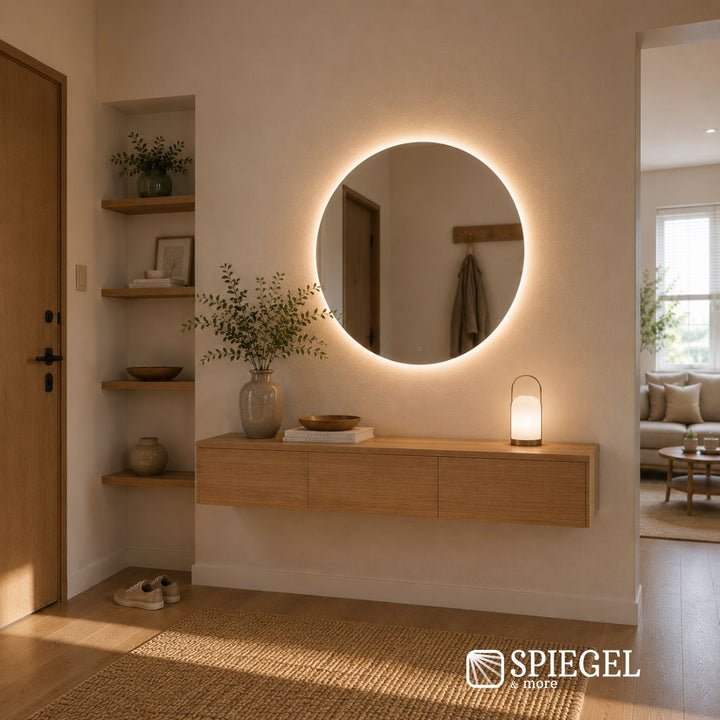
The Simple Round Light features a minimalist circular shape, suited to contemporary bathrooms.
Its understated appearance makes it easy to incorporate into different interior styles, while the LED lighting adds functionality.
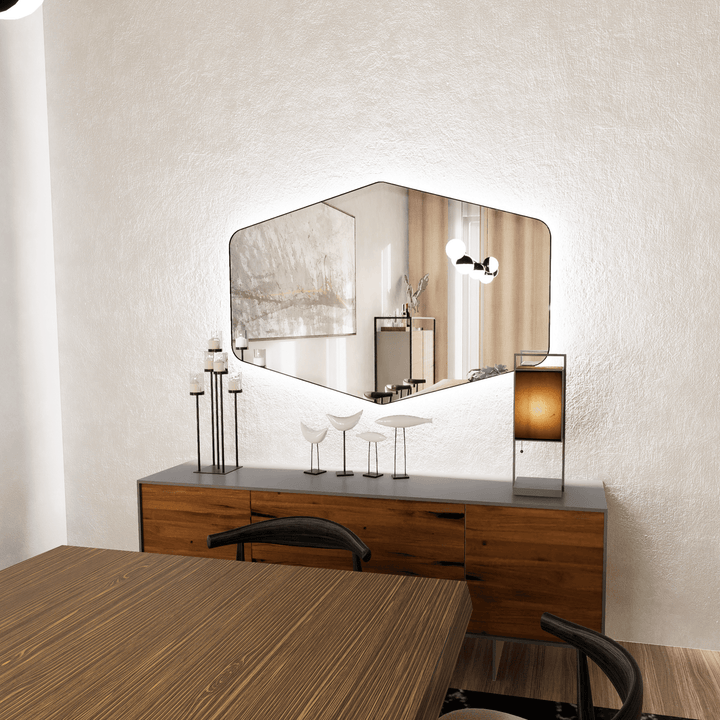
The Narzisse stands out for its distinctive design and ambient lighting, which highlights the mirror’s shape and the wall on which it is installed.
It is an option for anyone looking for a decorative piece with a striking visual presence.
Depending on the configuration selected, the model may include additional features, such as an anti-fog system.
The Auri combines a frameless design with soft lines and the option of ambient LED lighting.
Available in a classic mirror or bronze finish, it allows you to tailor the look to the style of the space.
Before choosing an illuminated mirror, consider a few key factors.
Dimensions: the mirror should be suitably proportioned to the furniture and the wall on which it will be installed.
Type of lighting: front lighting, backlighting or a combination of light sources, depending on the intended use.
Lighting controls: some models allow you to switch the light on using a switch or an integrated sensor.
Electrical installation: check the connection requirements and installation instructions provided by the manufacturer.
Bathroom suitability: check the technical specifications and whether the product is suitable for its intended installation area, particularly in spaces exposed to moisture.
Additional features: certain models offer options such as anti-fog systems, which can make the mirror more convenient to use.
In general, front lighting is better suited to tasks that require a clear view of the face. However, the result depends on the intensity, distribution and quality of the light.
Backlighting mainly provides ambient and supplementary lighting. It should generally not be considered the only light source in a bathroom.
LED technology is known for its energy efficiency compared with traditional lighting technologies. Actual consumption depends on the mirror’s power rating and how long it is used.
No. This feature depends on the model and configuration selected, so it should be checked in the product specifications.
Choosing between a front-lit LED mirror and a backlit model depends mainly on how you intend to use it.
For those who value lighting directed more towards the face, front-lit models are generally more suitable. Backlit mirrors stand out for their decorative effect and ability to create welcoming spaces.
At Spiegel & More, you will find a range of LED mirrors with shapes, finishes and features designed for different spaces.
Explore the Spiegel & More LED mirror collection and find the option that best combines lighting, design and functionality.


